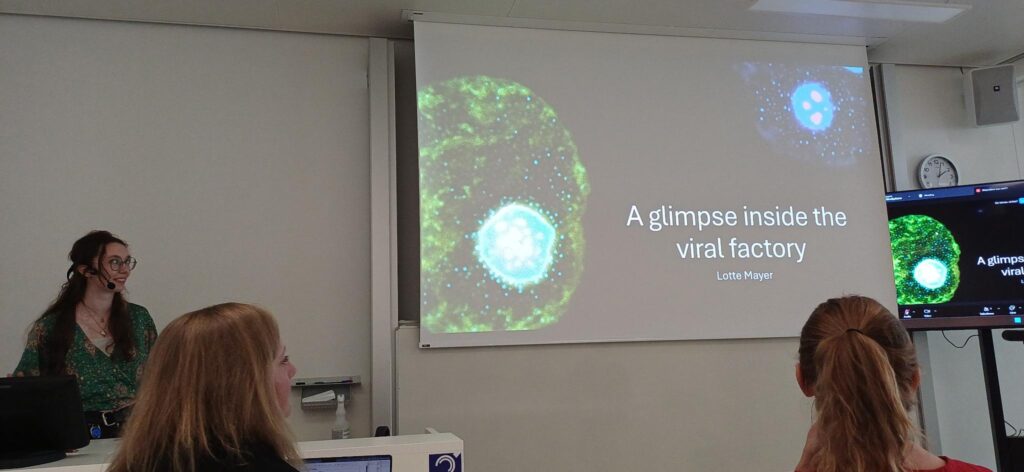
Back from the Viruses of Microbes 2026 conference at Prague last week . Me, Büşra, Dani, Dominik, and Laura all attended and, in total, presented our work though a talk and four posters on MGEs and competition, Tupanvirus gene expression, ecological interaction of giant viruses, and viruses and jumbophages in FMT. I have to say the conference stage was quite a thing, but we are now very excited looking forward to VoM 2028!
Last week, Elia successfully defended his Master thesis exploring Tupanvirus infection in amoeba. Elia joined the group as an Erasmus+ student from Radboud University and joined Dani and I in exploring defence systems of amoeba and Tupanvirus manipulation of its host. We very much enjoyed his stay in the group and wish him the best of luck as he prepares to start a PhD back at Radboud University. Can’t wait to see what he does next!
Along with a great team of experts on so-called giant viruses (AKA Nucleocytoviricota), we have published a review on the infection cycles of these curious large double-stranded DNA viral entities. We synthesise the information on the infection cycles of model representatives from the major orders within the phylum, revealing both shared traits and lineage-specific innovations. We compare the information available for the extensively studied taxa with insights from the rapidly expanding literature on the mimiviruses, pandoraviruses, marseilleviruses and pithoviruses. Finally, we highlight outstanding questions in the field, unify concepts across traditionally separated research areas, and provide a conceptual framework to guide future cell biology studies on large double-stranded DNA viruses.
Led by Dominik, we reconstructed high-quality genomes from diverse Waste-water treatment plants (61 novel nucleocytoviruses, 15 virophages and 14 polinton-like viruses). We aimed to study interactions among the players in this complex ecosystems. Through a multi-layered network analysis (looking at gene sharing, co-occurrence, and integration), we demonstrate nucleocytoviruses mediate the centrality of key interaction-hubs, and entities associated with NCVs strongly coincide with more central positions… meaning that while NCVs themselves do not rank among the most central (neither by degree or betweenness), NCV-connected microbial contigs assume dramatically elevated centrality compared to both unconnected microbes and the NCVs themselves. So, NCVs are key mediators of interaction.
Spearheaded by Ruixuan (visiting PhD student) with invaluable work from Lotte, we collaborated with the group of Hiroyuki Ogata (Kyoto University, Japan) to show that a giant virus (Acanthamoeba polyphaga mimivirus) generates a subcellular area to translate viral mRNAs. This virus encodes some tRNAs, however, RNA sequencing showed that the tRNA pool inside the host was not substantially altered during the viral infection. Using in situ labelling, we found that viral mRNAs and newly synthesized proteins were localized in the periphery of the viral factory, suggesting that the virus creates a discrete subcellular environment to facilitate translation. Frequently used codons in viral mRNAs had higher tRNA accessibility than the same type of codons in amoeba mRNAs. Together, the study shows how local translation helps the virus overcome the mismatch between tRNA supply and demand.
I recently visited the International Laboratory for Human Genome Research (LIIGH) and got to talk about all the cool virus research, past and present. It was a wonderful opportunity to connect with the community at this remarkable place in Mexico and share exciting science and ideas.
Last week we wrapped up the first edition of the Virus evolution and ecology course under the umbrella of the brand new Master in Microbiome Science offered at the University of Vienna. It was a blast to get to know the students and to sit for their presentations on selected topics. We learned about viruses, their evolution, and their ecological impact across different ecosystems.
The course was not only limited to lectures, but also to bioinformatic exercises where we went from database sequence download to tree building, inference of spillover events and recombination. For this, huge thanks to Alejandro, Büşra, and Dominik, for leading this bioinformatic hands-on part of the course. Definitely looking forward to the next edition!
Büşra talking to the class about influenza A virus
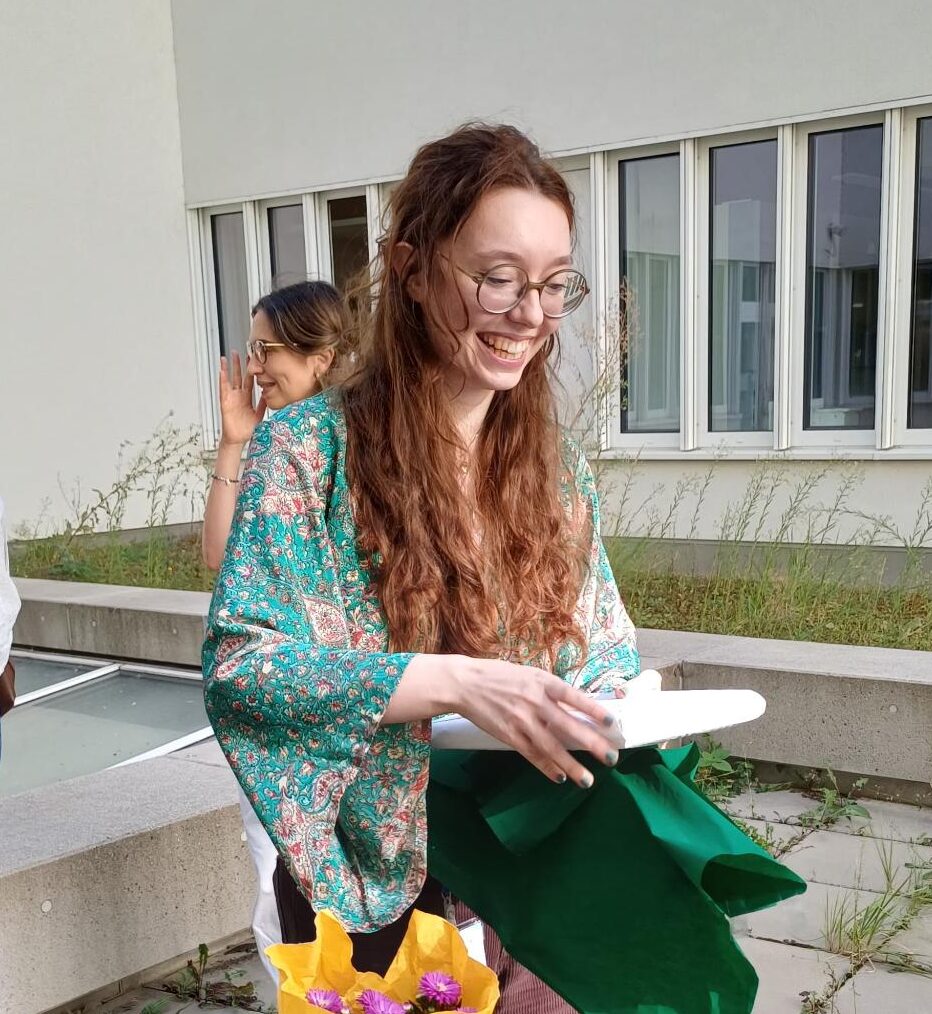
Today, the group was thrilled to see its first Master student, Lotte, successfully defend her thesis! From her time as an undergrad student to her Master’s work, Lotte has worked hard developing methods to study the viral factory of Nucleocytoviricota. Her hard work has paid of and she now finishes her master with two works (currently) available! This moment constituted a milestone for the group and of course a proud PI moment.
Congratulations Lotte!
Here below, some of her own, and collaborative work:
Mimivirus transcription and translation occur at well-defined locations within amoeba host cells. Journal of Virology, 99(7):e00554-25. https://doi.org/10.1128/jvi.00554-25
Last week ESEB2025 wrapped up. It was a great opportunity to chat with colleagues, hear about great evolutionary research, present the group’s work, and be a proud PI of Laura, who did a great job presenting her PhD work! Two years to go until next ESEB!
This last February, Büşra joined the VEE team to study the virome during fecal microbiota transplantation. This project falls within the FWF-funded Cluster of Excellence Microbiomes drive Planetary Health, which starts the expansion of the team beyond giant viruses. Welcome Büşra!
 Virus Ecology and Evolution (VEE)